
|
| thoughts & offerings |
October 21, 2014 Tadasana: What's Your Stance 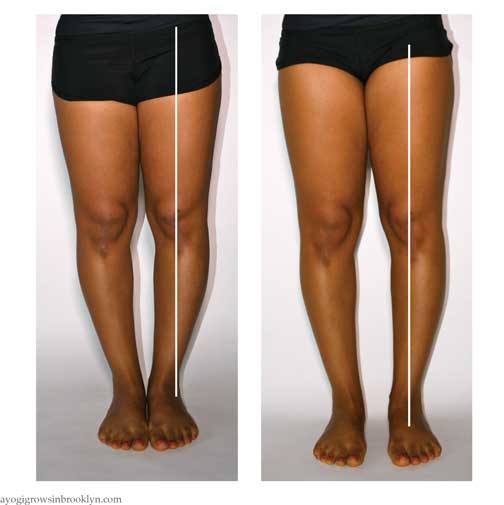 |
Tadasana (Mountain Pose) is a standing posture in yoga and is considered to be the basis of the alignment for many, if not all, standing poses in yoga. It is also referred to as "samasthiti" which, translates to "equal standing" or "correct standing position".
Many lineages of yoga teach Tadasana as standing with big toes touching. Some of my training lineages also have provided this alignment prompt. However, other lineages of yoga (and orthopedic sciences) advise that, for the optimal base of support, we should stand with feet slightly separated, with each foot underneath each hip point. In these standing posture images, you can view the rough line of impact/absorption at the joints (hip, knee, ankle.) The loading point appears to be more centered with the feet slightly separated. In the image, with the toes touching, the impact moves to the outer edge of the leg, which may put more strain on the lower body joints. My training and studies lead me to support a wider foot position for tadasana. Your correct standing position will vary, according to your own body, however, work to find the alignment that optimizes your posture, strength and joint health. Om, Shanti, peace. |
ADVERTISEMENT |
Tweet

|
October 7, 2014 8 Limbs of Yoga: Niyama 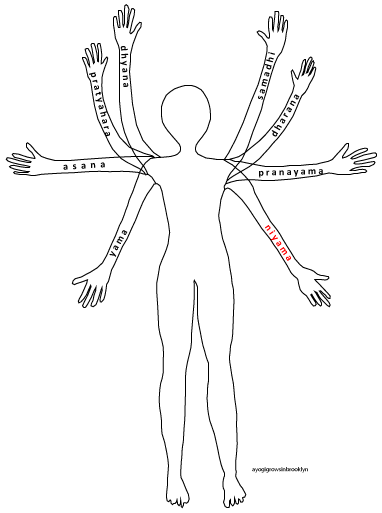 |
The second limb of the "Eight Limbs of Yoga" from the Yoga Sutras text is Niyama which means personal observances. These are related to spiritual practice and self discipline. Shaucha is cleanliness and working to gain purity of mind and thoughts. Santosha is contentment; a sense of peace with all things good and bad. Tapas is the effort one must dedicate towards becoming pure; the spiritual effort to reach your higher place Svadhyaya is spiritual study or self-study. The deep and continuous study of oneself as part of your spiritual growth. Isvarapranidanam is the surrender to god or a life of dedication to something higher. Try implementing niyama as part of your day to develop your own personal observances and rituals towards your higher self. Shanti. |
| older posts, newer posts return to main page |